
A question for system planners and OPERATIONAL ENGINEERS
The capacity is there,
The endurance isn't...
The Capacity is There.
The Endurance Isn't...
As renewable penetration increases beyond 70 per cent, UK and Irish systems are increasingly exposed to sustained periods of low renewable output that are not fully reflected in capacity-based metrics. Multi-day wind lulls are documented and recurring. Their system implications become more material as dispatchable capacity reduces.
We have prepared a short technical briefing note examining how multi-day renewable variability interacts with adequacy modelling and system operation. It is being shared directly with engineers and planners working on these questions.
The Situation
The transition is on track.
But the gap is growing.
The Transition Is On Track. The Gap Is Growing.
Offshore wind. Onshore wind. Solar. The build-out is accelerating across the UK and Ireland, and the targets are ambitious - 70, 80, even 95 per cent renewable penetration within the next decade. The planning frameworks are in place. The investment is flowing. The direction is right.
But beneath that progress sits a system characteristic present in almost every Future Energy Scenario — visible in modelling outputs, rarely treated as a distinct planning requirement.
It is not volatility. Frequency response and reserve products address short-term variability. It is not peak capacity. Installed capacity remains sufficient against traditional adequacy metrics.
It is duration.
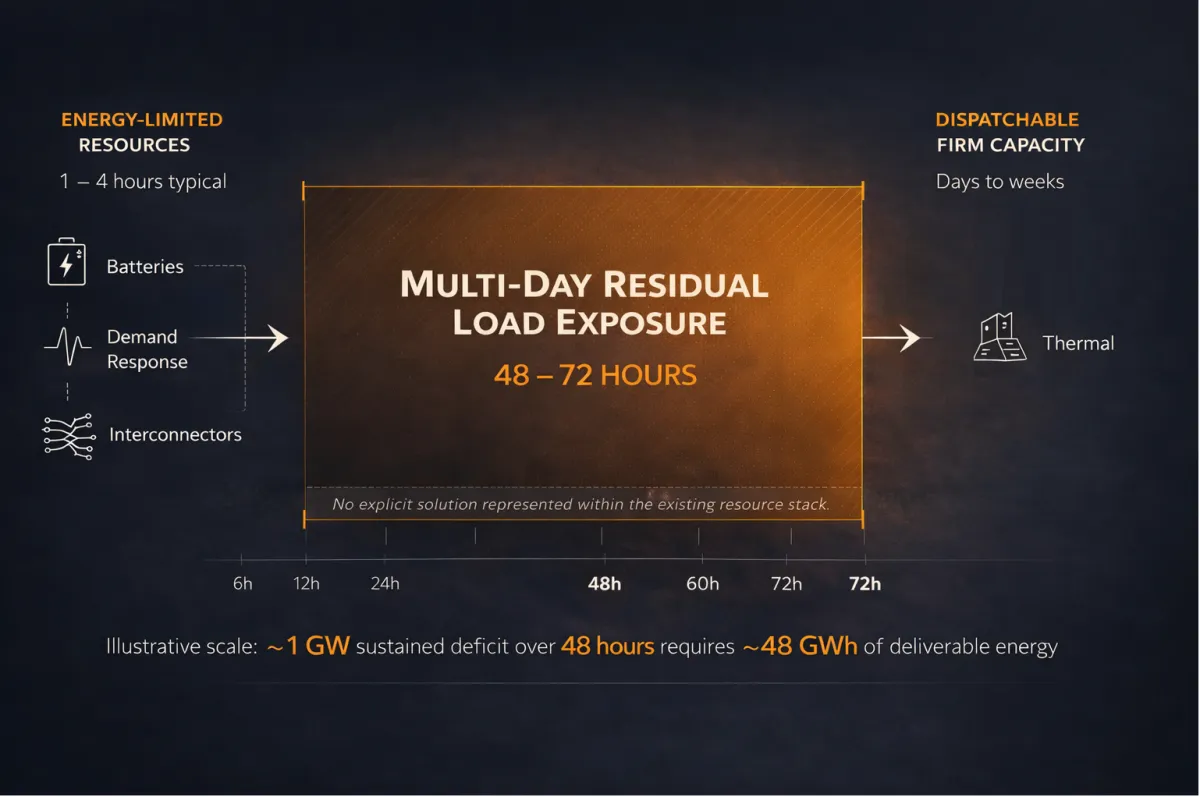
When wind generation collapses - not for minutes, not for hours, but for two or three consecutive days - the system faces a fundamentally different kind of problem. A 1 GW shortfall sustained over 48 hours represents a 48 GWh energy requirement. It is not a frequency event. It is not a ramping issue. It is a sustained energy balance requirement across consecutive settlement periods, and its explicit treatment within planning and operational frameworks is becoming increasingly material.
The Data
These conditions are already observable
2%
Wind generation share of total GB generation
September 2021 – wind share ~2% for multiple consecutive days
£2bn+
GB balancing mechanism and constraint costs
January to September 2025 (NESO reporting)
+91%
Increase in Scottish wind constraint volume
~3.5 TWh (2023) → ~6.7 TWh (2024)
In September 2021, wind generation across the GB system fell to roughly 2 per cent of the generation mix - and stayed there for days. System adequacy was maintained, supported by available dispatchable thermal capacity.
A proportion of that dispatchable capacity is scheduled to retire over the coming decade.
The economic consequences are already visible. Balancing and constraint costs in the GB system have risen sharply. Curtailment in Scotland is growing - renewable energy generated, available, and discarded - while gas plant is simultaneously dispatched in England to maintain stability. This reflects simultaneous curtailment and thermal dispatch under system constraints.
"Future Energy Scenarios with high renewable penetration assume sufficient energy-shifting capability across extended low-output periods. In practice, the duration requirement is not always represented as a distinct system constraint."
The Question
What sits between 4-hour storage and firm thermal capacity?
Short-duration battery storage is deployed for frequency response and intra-day balancing. Interconnectors provide trading flexibility. Demand-side response is growing. These are established components of current system operation.
None of them address sustained multi-day residual load exposure.
A 4-hour battery provides limited contribution to a 48-hour low-wind event. Interconnector adequacy depends on neighbouring markets maintaining surplus energy. Meteorological data indicates that extended low-wind events are frequently spatially correlated across Northern Europe. Low-wind conditions across the North Sea region are frequently coincident with reduced output in the Irish Sea.

Meteorological Evidence
Multi-day low-wind events are observable in historical weather-year datasets. These events persist for 48–72 hours and exhibit cross-regional correlation.

Economic Exposure
Balancing and constraint costs in the GB system exceeded £2 billion in the first nine months of 2025. Curtailment in Scotland rose 91 per cent in 2024. These are realised system costs.

Planning Framework Gaps
Adequacy metrics are primarily capacity-based and do not explicitly represent sustained multi-day energy deficits. Explicit modelling of consecutive-day residual load exposure is not consistently treated as a distinct requirement.
IMPLICATIONS
Implications for system planning
As renewable penetration moves beyond 80%, adequacy exposure increasingly depends on chronological energy balance across multi-day weather events.
Installed capacity may be sufficient under peak demand conditions, while residual load duration across extended low-wind periods remains underrepresented in planning frameworks.
We have been examining weather-year simulations, residual load duration curves, curtailment patterns and constraint costs across UK and Irish systems to understand how multi-day exposure is currently treated in adequacy and operational modelling.
This discussion is relevant to those involved in:
Chronological adequacy modelling
Stress-year and weather correlation analysis
Capacity market design assumptions
Operational treatment of extended renewable deficits
If your work touches the representation of 48–72 hour renewable correlation events in planning or operational frameworks, we would value a technical discussion.
Join the Conversation
We are mapping the endurance gap
We Are Mapping the Endurance Gap
We have produced a technical briefing note that sets out the problem
in detail - the meteorological evidence, the adequacy modelling gaps,
the economic exposure, and the infrastructure characteristics that a
credible solution would need to have.
We have produced a technical briefing note that sets out the problem in detail - the meteorological evidence, the adequacy modelling gaps, the economic exposure, and the infrastructure characteristics that a credible solution would need to have.
We are sharing it directly with people who are working on these questions.
The conversation that needs to
happen
The Conversation That Needs to Happen
How should UK and Irish power systems prepare for multi-day renewable endurance
as dispatchable capacity retires and renewable penetration continues to rise?
We do not think this question has been answered. We do think it is becoming
impossible to avoid.

© 2026 Static Hydro Energy. All rights reserved.
For discussion purposes. Prepared for system planners, operational engineers, and infrastructure decision-makers.
For discussion purposes. Prepared for system planners, operational engineers, and infrastructure decision-makers.